

There are things we postpone for surprisingly respectable reasons.
The long trip can wait until work settles down. The friend who lives three hours away will still be there next year. The guitar can stay in its case until there is more time. The hike will be easier to organize once the calendar clears.
None of these decisions feels particularly dramatic or urgent.
That is partly why they are so easy to repeat.
Years later, the calendar may still be full. The friend may have moved. Your knees may have opinions about the hike. And the version of you who was supposedly going to have more time has become the version of you wondering where it went.
Time management was the problem you worked on.
But the real problem was time’s finitude.
The Fantasy of Later
Most of us know intellectually that life is finite, but we aren’t very good at keeping it conscious and altering our behavior accordingly.
Oliver Burkeman gave this an appropriately uncomfortable number in Four Thousand Weeks. Live to around eighty and that is roughly what you get.
Four. Thousand. Weeks.
The immediate temptation is to turn that into another optimization challenge. Better schedule the weeks. Protect the mornings. Reduce distractions. Become highly efficient at squeezing the maximum amount of life out of every available Tuesday.
Which misses Burkeman’s point almost completely.
Finitude means there will never be enough time for everything you could reasonably want to do. Becoming more efficient does not solve that. In many cases, efficiency simply creates room for more things to compete for the same finite life.
At some point, the question changes from:
How do I fit everything in?
to:
What is worth leaving other things undone for?
That is a much harder question.
Time Is Not Money
Successful people are particularly vulnerable to thinking about time like capital.
Invest it well. Avoid waste. Improve the return. Protect the asset.
There is some wisdom in that. There is also a fairly important difference.
Money can accumulate.
Your 4,000 Tuesdays cannot.
Bill Perkins makes this distinction particularly well in Die With Zero. His argument is not simply “spend your money before you die,” which would be a rather short book. He asks readers to consider the relationship between money, time and health.
An experience available to you at fifty may technically remain available at seventy-five. But you may not experience it in the same way.
A multi-day trek, a month abroad, learning to surf, carrying a child on your shoulders, staying up until two in the morning talking with old friends: these things have windows.
Money has a remarkable ability to preserve options.
Life does not promise to preserve your capacity to use them.
That makes postponement more expensive than it first appears.
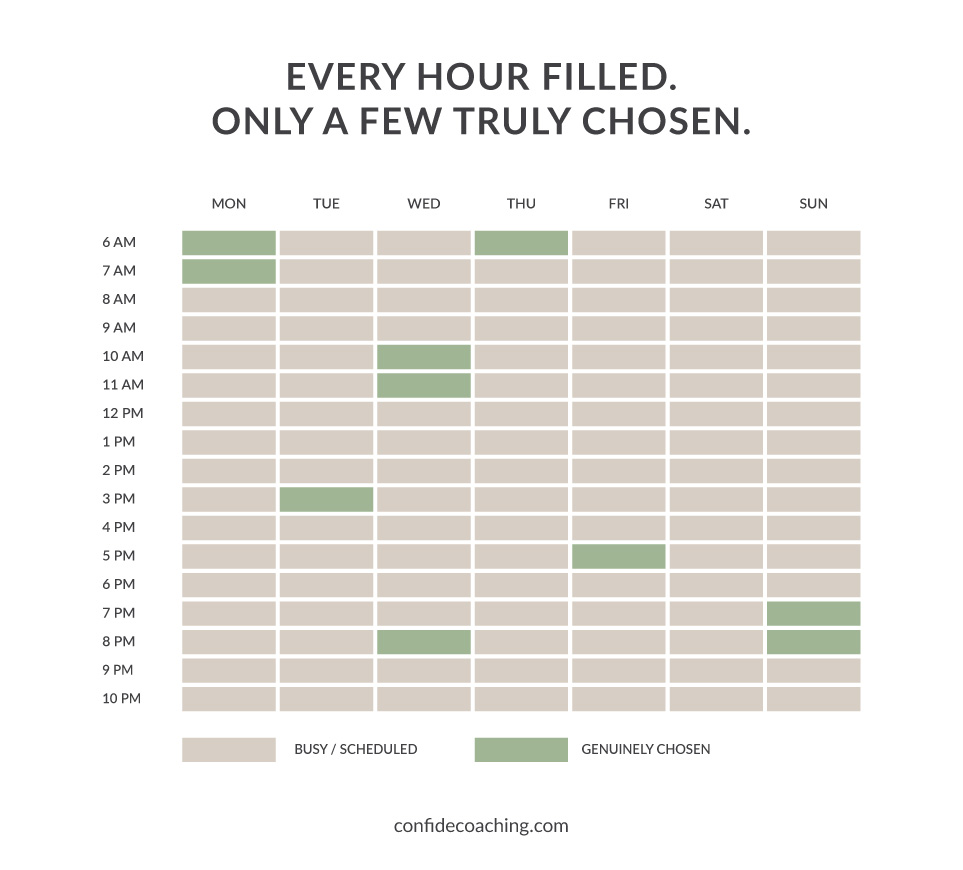
The Calendar Is Full of Good Things
The difficulty is that most people I work with are not wasting their lives doing obviously pointless things.
Their calendars are full of legitimate responsibilities and interesting opportunities.
The meeting matters. The company matters. The board position is worthwhile. The person asking for help deserves an answer.
This makes subtraction difficult.
We tend to imagine that living more deliberately means identifying the stupid things and removing them. If only it were that easy.
Usually, the competition is between things that are all defensible.
A successful person can fill every remaining year with meaningful work and still discover that some other meaningful parts of life received whatever was left over.
Relationships.
Health.
Curiosity.
Time outside.
Doing something badly because you enjoy it (my wife and I are learning coastal rowing, after only having experience with a Concept2 rower!).
Nothing on a quarterly report will announce that these have been underfunded.
You notice later.
Mortality Is Useful Information
The Stoics had a practice that now sounds darker than it was intended to be: memento mori, remember that you will die.
It was not an invitation to start worrying.
It was a prompt to see the present more accurately.
Seneca complained nearly two thousand years ago that people behaved as though time were abundant while guarding their property obsessively. His argument in On the Shortness of Life was that much of the problem was not simply the length of life, but how casually people allowed their time to be claimed.
The language is ancient. The calendar problem is impressively still current.
Awareness of mortality has a way of changing the value of things.
Some annoyances shrink immediately.
Some postponed conversations become less postponable.
A project you assumed you “should” do may suddenly look like three years of your life you never actually chose.
This does not mean every decision should be made under the imagined shadow of death. That would become exhausting and stressful rather quickly.
Mortality is useful because it introduces a constraint that reality has already imposed.
There is an end.
You do not know exactly where it is.
Plan accordingly.
Different Questions in the Second Half
James Hollis writes about the second half of life as a period when the questions themselves begin to change.
Earlier adulthood is often occupied with entering the world: establishing yourself, building relationships, creating a career, meeting responsibilities and discovering whether you can do what the world requires of you.
Later, another question becomes harder to avoid.
Given what I now know, what is worth my remaining (and dwindling) time?
The word remaining can make people uncomfortable.
I think it improves the question.
If you have built financial security, professional competence and a degree of autonomy, you have something many people spend their lives trying to acquire: choice.
But choice without limitation is meaningless.
You choose because you cannot do everything.
You commit to one thing because doing so prevents you from giving the same hour to another.
That's what gives the decision weight.

What Deserves a Tuesday?
I do not think the answer is to construct a perfectly meaningful calendar.
That sounds miserable.
Some Tuesdays need to contain tax forms, dentist appointments, airport delays and forty-five minutes trying to remember a password you apparently created yourself.
A finite life still contains administration.
The more useful question is whether the larger pattern reflects your stated priorities.
If health matters, does it receive time while you still have it?
If relationships matter, are they actually present in the week?
If curiosity matters, is there room for something with no obvious economic return?
If freedom mattered enough to spend decades creating it, where can you see it?
Mortality does not demand urgency.
It asks for honesty.
There will always be more worthwhile things than there is time to do them.
The work is not squeezing them all in.
It is deciding which ones are worth a piece of the life you actually have.
Paul Strobl, MBA, CPC
Owner of Confide Coaching, LLC
Paul Strobl is a Personal Coach for Founders and Executives navigating the space between what they've built and what comes next. Native Texan. Ten years in Argentina. Now based in the Rhodope Mountains of Bulgaria with his wife, adopted son, and a rescued Posavac Hound.
An Anthropology degree sparked a lifelong fascination with why people do what they do. A Thunderbird MBA and twenty years of private coaching later — he works one-on-one, by phone, with a small number of clients worldwide.
If anything here resonated, this is the logical next step.
The Second Half of Life Audit takes less than ten minutes and tends to surface things worth knowing.