

Why Multipotentialite Entrepreneurs Struggle and Shine
“You’ve never fit neatly into one box — and that’s your superpower. But in the world of business, it can feel like a liability.”
As a curious mind myself, I know this tension all too well. In my early years of coaching, I felt lit up by the endless possibilities the entrepreneurial world offered. Each new idea sparked a flurry of excitement, a chance to join emerging ventures, launch a passion-driven startup, test out creative business models, or build something entirely my own from the ground up. I had vision, I had drive. But over time, I realized something important: I was spreading myself too thin. My energy was scattered, my focus fragmented, and I wasn’t gaining the traction I knew I was capable of. It wasn’t that I lacked commitment, I simply hadn’t learned how to work with my wiring instead of against it.
That insight became a turning point.
You see, if you’re someone with a wide range of interests, who lights up at the thought of building multiple ventures or exploring different industries, chances are you’re a multipotentialite. It’s a term coined and championed by Emilie Wapnick, who captured this experience so powerfully in her TED Talk, Why Some of Us Don’t Have One True Calling. When I first watched that talk, I felt like she’d just voiced the TED Talk I had in my own head. I even reached out to her afterwards to tell her so — which led to us collaborating, and me joining a select group of life coaches who served her growing community of multipotentialites.
Multipotentialites are people who aren’t wired to follow a single linear path. They thrive on variety, growth, and creative synthesis. And when they step into the world of entrepreneurship, this can manifest as launching multiple ventures, blending disciplines, or constantly evolving their business model.
But here’s the rub: society still tends to celebrate the specialist, the person with a clear, narrow focus who climbs a single ladder with unwavering commitment. Multipotentialites, with their love for breadth, are too often misunderstood. We’re seen as unfocused, unrealistic, even flaky. And that external bias can easily turn inward, becoming self-doubt and imposter syndrome.
This article is for you if you’ve ever questioned whether you’re “too scattered,” or whether your multi-passionate mind is holding you back. It’s not. In fact, it may be your greatest asset, if you learn how to harness it well.
We’ll explore how multipotentialite entrepreneurs can thrive by embracing their strengths, recognizing their vulnerabilities, and building the right support system. One of the tools I’ll introduce is the BOSI DNA framework, a powerful way to understand your entrepreneurial wiring and, more importantly, to find the right people to team up with — so you don’t have to choose between your passions and your success.
Let’s get into it.
What Is a Multipotentialite Entrepreneur?
Being a multipotentialite isn’t just a personality quirk, it’s a way of moving through the world, especially in business. Multipotentialite entrepreneurs are people with a wide range of interests and talents, drawn to more than one business idea, industry, or area of expertise.
This isn’t just dabbling, it’s a genuine pursuit of mastery in more than one area. You’re driven by curiosity, fueled by learning, and inspired to turn ideas into ventures that reflect everything you care about.
In contrast to specialists — those who go deep in one field and build mastery over time — multipotentialites are driven by breadth. You’re often less interested in climbing a single career ladder and more excited by weaving together different strands of experience to create something new. Where specialists thrive on consistency, you thrive on variety. Where they value depth, you value synthesis.
Emilie Wapnick describes three key strengths that define multipotentialites:
1. Idea Synthesis: The ability to combine knowledge from different fields into innovative solutions.
2. Rapid Learning: A quick grasp of new concepts — often good enough to reach competency faster than most.
3. Adaptability: Comfort with change, fluid identity, and a willingness to shift direction when needed.
These traits make multipotentialite entrepreneurs incredibly valuable in a world that rewards creativity, innovation, and agility. They spot patterns others miss. They can pivot with ease. And they often see opportunity at the intersection of seemingly unrelated industries.
Just look at some of the most successful multipotentialite entrepreneurs:
- Elon Musk isn’t just running one company, he’s driven innovation across space travel (SpaceX), electric vehicles (Tesla), AI, brain-computer interfaces (Neuralink), and infrastructure (The Boring Company). He builds cross-domain solutions for complex, real-world problems. For the sake of sanity, we’ll leave his latest political ventures out of this, but there’s no denying his ability to leverage expertise across multiple industries to push boundaries and shape the future.
- Maya Penn started her first eco-fashion company at age eight, then expanded into tech, animation, social entrepreneurship, and public speaking. She’s a textbook example of how young multipotentialites flourish when supported.
- Richard Branson built the Virgin brand across airlines, music, health, and even space tourism. His empire isn’t built on sameness, it’s built on vision, risk-taking, and range.
These entrepreneurs aren’t anomalies, they’re examples of what’s possible when a multipotentialite leans into their wiring instead of resisting it. The challenge, of course, is learning to focus without shutting down. That’s where strategic frameworks and coaching can make all the difference.
In the next section, we’ll look at why the world still misunderstands multipotentialites and how those external biases can become internal roadblocks if left unaddressed.
Cultural Bias Against the Generalist
From early education to corporate hierarchies, we’re taught a simple narrative: pick one thing, get really good at it, and stick with it. Schools reward subject mastery and narrow expertise. Career paths are laid out like ladders, climb one rung at a time in a straight line. Specialization isn’t just encouraged; it’s expected. And for those of us who thrive on variety and multidimensional thinking, this message can feel suffocating.
Multipotentialites quickly learn that their way of operating doesn’t fit the mold. Their curiosity gets labeled as distraction. Their breadth of interests is seen as a lack of direction. The world doesn’t always know what to do with someone who wants to build a consulting business and start a tech company and write a book on the side.
The stereotypes follow fast:
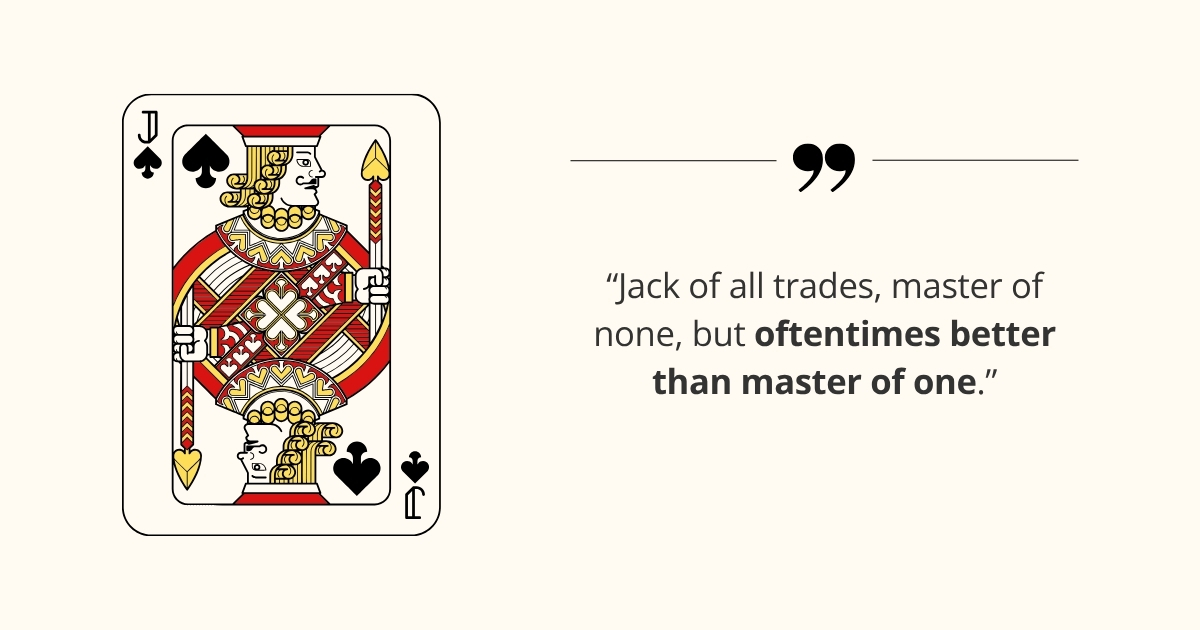
“Jack of all trades, master of none.”
But what most people forget is the full quote:
“Jack of all trades, master of none, but oftentimes better than master of one.”
That changes everything.
When that incomplete version is all you’ve heard, it’s easy to internalize the bias. Over time, many multipotentialites begin to feel like there’s something wrong with them. That they lack focus. That they’re failing by not choosing a single direction. The result? Shame, confusion, analysis paralysis, and burnout from trying to force themselves into a path that was never meant for them.
But here’s the truth – your wiring isn’t faulty. It’s different, and that’s exactly what gives you your edge. As Barbara Sher reminds us in Refuse to Choose!, this way of thinking isn’t a flaw to fix, but a strength to understand.
To move forward, you don’t need to force yourself into someone else’s mold, you need a new narrative. One that replaces “What’s wrong with me?” with “How can I build a life and business that works with how I’m naturally wired?”
That shift changes everything. It’s the first step in reclaiming your confidence, your clarity, and your right to build on your terms.
The Shadow Side: Common Struggles of Multipotentialite Entrepreneurs
Of course, being wired for variety doesn’t mean it’s always easy. Multipotentialite entrepreneurs face a unique set of challenges, not because they’re flawed, but because the systems around them aren’t built with their operating style in mind.
1. Overwhelm and idea fatigue
When everything excites you, it’s hard to know where to start, or when to stop. Many multipotentialites bounce between ideas, constantly in motion but rarely gaining momentum. The result is a cycle of half-finished projects and lingering guilt.
2. Difficulty with execution
Starting is exhilarating. Finishing, not so much. Once the novelty wears off, a new idea often pulls attention elsewhere. Multipotentialites thrive in the ideation and building phase, but can struggle with follow-through, especially on routine or repetitive tasks.
3. Inconsistent revenue or messaging
Running multiple ventures at once can make it hard to build a clear brand or reliable income stream. One day you’re consulting in one field, the next you’re launching a new product in another. This kind of variety brings creative joy, but without strategy, it can look chaotic from the outside.
4. Fear of commitment
Choosing one direction often feels like abandoning ten others. Multipotentialites may delay decisions or self-sabotage progress out of fear that committing to one path means shutting the door on everything else.
5. Lack of external understanding
Colleagues, investors, even close friends may not understand why you won’t just “pick something and stick with it.” Their confusion, or skepticism, can amplify your own self-doubt.
This is where coaching can be transformative. The goal isn’t to make you choose less. It’s to help you choose better, with clarity, alignment, and a structure that supports the way your brain naturally works.
In the next section, we’ll explore the strengths that come with this way of thinking, and why, in a rapidly changing world, multipotentialites are often best equipped to lead innovation.
Superpowers of Multipotentialite Entrepreneurs in a Rapidly Changing World
While the world may not always understand multipotentialites, it increasingly needs them.
In a time of rapid change, where industries are merging, technologies are evolving overnight, and innovation happens at the edges of disciplines, the ability to think broadly, pivot quickly, and synthesize ideas from multiple fields is a competitive advantage, not a liability.
As David Epstein argues in his book Range: Why Generalists Triumph in a Specialized World, the people who succeed in unpredictable, complex environments aren’t always the specialists, they’re the ones who can connect dots across domains, learn quickly, and think adaptively. In other words: people like you.
Multipotentialite entrepreneurs bring a powerful mix of qualities that traditional business training often overlooks:
1. Adaptability
You’re used to navigating unfamiliar terrain. Shifting gears doesn’t scare you — it excites you. In volatile markets or during times of disruption, this flexibility becomes a superpower. While others panic, you retool. You create. You move.
2. Idea synthesis
One of the core traits multipotentialites bring to entrepreneurship is the ability to draw connections between seemingly unrelated fields. You might take a tool from tech and apply it to wellness, or borrow a design principle from architecture to reshape a digital course. This ability to cross-pollinate ideas is what sparks true innovation.
Here are just a few examples of idea synthesis in action:
- Psychology + UX Design + Storytelling = Transformational Digital Courses
A founder uses their background in psychology to shape emotionally engaging online courses that incorporate UX principles and narrative design — helping students not only learn, but stay motivated and finish.
- Culinary Arts + Sustainability + Social Enterprise = Zero-Waste Community Kitchens
A chef passionate about the environment launches a nonprofit kitchen that transforms surplus produce into meals while teaching low-cost cooking skills to underserved communities.
- Biotechnology + Art + Marketing = Bio-Interactive Brand Installations
A multipotentialite blends bioengineering with design to create living, interactive brand experiences — turning sustainability into a sensory, shareable story.
- Personal Finance + Gamification + Behavioral Science = A New Budgeting App
Someone fascinated by money psychology and game mechanics builds a personal finance app that uses habit loops, nudges, and rewards to help users change their financial behaviors — and actually enjoy doing it.
- Education + Coding + Music = Custom AI Learning Tools for Neurodivergent Kids
A teacher-turned-coder with a love of music develops adaptive learning software that uses rhythm and sound to teach language and math skills to children with learning differences.
This kind of thinking doesn’t fit neatly into one job title — and that’s exactly the point. Multipotentialites invent categories where none existed before.
3. Rapid learning
Multipotentialites often learn faster than average — not because they’re smarter, but because they’re practiced at jumping into new domains. You know how to find what matters quickly, self-educate, and build momentum with just-in-time knowledge.
4. Big picture thinking
While specialists zoom in, you zoom out. You see patterns across systems, industries, and people. That makes you well-suited to leadership roles, vision-setting, and identifying untapped opportunities that others miss.
5. Creative problem-solving
Because you’ve explored different tools and ways of thinking, you’re not limited to a single framework. You tend to ask better questions — and see multiple solutions when others only see roadblocks.
Take a look at today’s most innovative entrepreneurs, and you’ll find these qualities at the core of what makes them successful. Multipotentialites aren’t just surviving in this new economy — they’re uniquely equipped to lead it.
But even with these strengths, one truth remains: thriving as a multipotentialite doesn’t mean doing everything alone. It means finding the right strategy — and the right people — to help your ideas take root and grow.
In the next section, we’ll explore why you don’t need to be “everything” in your business — and how tools like BOSI DNA can help you team up with the right partners to bring your vision to life.
The Missing Piece: You Don’t Need to Do It All Alone
There’s a persistent myth in the entrepreneurial world — the myth of the solo genius. The visionary who singlehandedly builds an empire from scratch, powered solely by grit, caffeine, and sheer brilliance. But even the most iconic entrepreneurs didn’t do it alone. And if you’re a multipotentialite, trying to do everything yourself isn’t just inefficient — it’s a fast track to burnout.
Multipotentialite entrepreneurs often carry an extraordinary amount of creative energy. You’re full of ideas, quick to learn, and able to jump into new projects with enthusiasm. But without the right support, that same energy can turn into a double-edged sword.
You need partners, not because you’re lacking, but because your brilliance deserves structure and support.
Here’s why teaming up is especially crucial for multipotentialites:
- To ground execution
You thrive in the ideation phase, but translating ideas into scalable, consistent action can be draining. A strong partner helps get things done.
- To build systems and maintain momentum
Systems aren’t always exciting, but they’re essential. Collaborators who love structure can keep things running while you drive vision.
- To protect from shiny object syndrome
New ideas are your fuel — but they can also become distractions. The right partner helps you evaluate what’s truly worth pursuing now versus later.
- To maintain accountability
When you work across multiple projects, it’s easy to lose track of timelines or priorities. External accountability keeps you moving with intention.
So how do you find the right people to team up with? That’s where the BOSI DNA framework comes in.
Understanding Your Entrepreneurial DNA
The BOSI (Builder–Opportunist–Specialist–Innovator) DNA system is a powerful tool for understanding your entrepreneurial personality — and just as importantly, who you work best with.
Here’s a quick breakdown of the four types:
- Builder – Driven, process-oriented, focused on scaling and structure.
- Opportunist – Fast-moving, intuitive, thrives on trends and quick wins.
- Specialist – Detail-oriented, loyal, and best in deep, focused work.
- Innovator – Big-picture thinker, idea generator, problem solver.
Most multipotentialites test as Innovators or Opportunists — natural visionaries who love exploring new territory. But Innovators often struggle with consistent implementation, while Opportunists can jump ship when the excitement fades.
That’s why partnering with Builders and Specialists can be a game-changer. They bring the grounding force, structure, and long-term commitment that complement your expansive thinking.
In coaching, one of the most transformative insights for clients is realizing: You don’t have to become someone you’re not. You simply need to build around how you’re wired. By understanding your entrepreneurial DNA, and learning to team up with people who balance your blind spots, you move from spinning plates to building something truly sustainable.
How Coaching Helps Multipotentialite Entrepreneurs Harness Their Gifts
Multipotentialite entrepreneurs are wired for creativity, innovation, and possibility, but without the right framework, those strengths can become overwhelming. This is where coaching comes in.
A skilled coach doesn’t tell you to “just focus” or “pick one thing.” Instead, they help you create structure around your curiosity, so that your ideas can translate into traction. Coaching becomes the bridge between potential and execution, especially for someone with a nonlinear path.
Here’s how coaching specifically supports multipotentialites:
1. Clarity without constriction
Coaching helps you sort through your ideas and uncover the common threads. You don’t have to choose just one, but you do need clarity on what matters most right now. Your coach helps you identify your themes, define your core message, and build coherence across projects — without sacrificing range.
2. Strategy that reflects how you’re wired
Multipotentialites don’t thrive on rigid five-year plans. Coaching provides a flexible, adaptive approach, one that respects your love of change, but still sets strategic goals with measurable outcomes. You’ll learn how to work with your entrepreneurial DNA instead of against it.
3. Systems and structure to support momentum
You bring the vision, your coach helps you build the container. Together, you develop habits, workflows, and systems that keep you moving forward without burnout. Think scaffolding for your creativity, not limits on your freedom.
4. Accountability without pressure
With so many moving parts, it’s easy for multipotentialites to lose momentum or jump to the next idea before the last one is finished. A coach provides grounded, nonjudgmental accountability, helping you stay aligned with your goals while still leaving room for exploration.
5. Team design and delegation
You don’t have to wear every hat in your business. Coaching can help you identify which roles and responsibilities to keep, and which to outsource, automate, or delegate. Tools like BOSI DNA make this process even more precise, helping you build a team that complements your strengths rather than duplicates them.
When you stop trying to “fix” your multipotentiality and start designing around it, everything changes. You gain traction. You feel energized, not scattered. You build momentum instead of cycling in and out of burnout.
In the final section, we’ll bring it all together, and show why the multipotentialite mindset may not just be viable, but essential in the future of entrepreneurship.
Designed for Change: Why the Future Needs You
If you’ve ever felt like your brain works differently, like your interests shift faster than most people can keep up with, that’s not a flaw. It’s not a phase. It’s a feature. And in the world we’re moving into, it may be one of the most valuable features of all.
We’re living in a time defined by complexity, rapid change, and constant reinvention. The problems businesses are trying to solve don’t live neatly within one field anymore. The next generation of innovation is happening between disciplines, at the intersections, where fresh thinking is required.
This is exactly where multipotentialites shine.
Your ability to draw from different domains, synthesize insights, and generate original ideas isn’t just a creative quirk, it’s a strategic advantage. This kind of idea synthesis is how innovation happens. And as traditional industries blend and new ones emerge, people who can think across boundaries will be the ones building what comes next.
But thriving in this new landscape doesn’t mean doing it all alone. It means getting smart about structure, support, and strategy. It means finding the right partners who complement your strengths, and using tools like BOSI DNA to build a team around your entrepreneurial wiring, not in spite of it.
Most importantly, it means giving yourself permission to build a business that honors all of who you are, not one that asks you to become someone else.
You weren’t meant to fit into the old mold. You were designed for change.
And the future?
It needs exactly what you bring.
Ready to turn your range into real traction?
Take the BOSI DNA assessment to discover your entrepreneurial profile — and find out who you need on your team to bring your ideas to life. If you’re ready to build a business that honors all of who you are, coaching can help you create the clarity, structure, and strategy to make it happen.
Let’s design a path that works with your wiring — not against it.

Paul Strobl, MBA, CPC
Owner of Confide Coaching, LLC
Paul is a Master Life Coach for GenX and GenY executives and business owners. Originally from Houston, Texas, he has been location independent for most of his adult life. He currently resides in the Rhodope Mountains of Bulgaria near the Greek border with his brilliant wife, 15-year-old stepson (officially adopted in 2021!) and a Posavac Hound rescue.
Paul is also a Certified BOSI Partner, Executive Coach, and Entrepreneurial DNA practitioner who has delivered BOSI-based workshops for MBA programs, accelerators, and leadership teams worldwide.
References
Epstein, D. (2019). Range: Why Generalists Triumph in a Specialized World. New York, NY: Riverhead Books.
Sher, B. (2006). Refuse to Choose!: A Revolutionary Program for Doing Everything That You Love. New York, NY: Broadway Books.
Wapnick, E. (2015, April). Why some of us don’t have one true calling [Video]. TEDxBend. https://www.ted.com/talks/emilie_wapnick_why_some_of_us_don_t_have_one_true_calling
Confide Coaching. (n.d.). Entrepreneur Assessment – BOSI DNA. https://confidecoaching.com/entrepreneur-assessment-bosi-dna/