

Most entrepreneurs think their biggest challenge is strategy or capital. In reality, the hardest part of building a business is fit — the alignment between who you are and what your company needs at each stage of growth.
If you’ve already read The Four Entrepreneurial DNAs Explained and What Is the BOSI Framework?, you know how the Builder, Opportunist, Specialist, and Innovator patterns shape decision-making and culture.
This third article looks at what happens when those patterns hit the real world; how they play out inside companies you already know, and why some combinations scale while others stall.
Builder DNA: How System-Driven Leaders Scale Businesses
Builders are the architects of scale. They’re wired to create order from chaos and to design structures that can hold weight long after the founder has stepped away. They don’t just build businesses; they build machines.
Take Starbucks under Howard Schultz. It started as a small Seattle coffee shop and became a global experience defined by repeatability. Every detail — store layout, staff training, the smell when you walked in — was designed to produce the same emotional moment anywhere on earth. Schultz wasn’t chasing coffee trends; he was building infrastructure around a feeling.
The same pattern shows up in Netflix under Reed Hastings. What began as a DVD-by-mail service evolved into a platform that redefined entertainment distribution. Hastings’ real genius wasn’t the idea of streaming — it was the system that made streaming scalable.
That’s the Builder signature: turn creativity into a process, process into performance, and performance into a platform for more growth. The danger comes when the system becomes sacred. Builders can over-engineer or expand faster than culture and leadership can sustain.
Opportunist DNA: The Entrepreneur Who Thrives on Timing
Opportunists are kinetic. They read markets the way surfers read water — watching for movement, tension, and timing. Their edge is intuition paired with action.
Virgin Group is a masterclass in this pattern. Richard Branson’s career is a study in momentum: music, airlines, mobile, space. He rarely invents; he reframes. Branson spots inefficiencies in existing markets, injects energy and personality, and turns stale industries into playgrounds for the customer experience.
You see a similar instinct in Spanx, where Sara Blakely turned a single observation — a need for smoothing under white pants — into a billion-dollar brand. She caught a cultural wave and built a category around it.
Opportunists thrive on timing, charisma, and speed. They can mobilize people and resources before the ink dries. But their strength carries a cost: focus. When every idea feels urgent, they risk scattering their energy across too many plays. The hardest lesson for an Opportunist is that saying no is what creates staying power.
Specialist DNA: Why Depth and Mastery Build Trust
Specialists are driven by depth. Their loyalty is to the work itself — to precision, mastery, and consistency. They’d rather refine than reinvent, and they grow through reputation rather than disruption.
Look at Patagonia. Yvon Chouinard never set out to build an empire. He wanted to make gear that lasted and to prove that a company could protect the environment and still prosper. That devotion to craft and principle became Patagonia’s brand before “brand purpose” was a buzzword.
Berkshire Hathaway reflects the same DNA. Warren Buffett’s strategy isn’t flashy; it’s disciplined, patient, and methodical. His success comes from trusting a clear set of principles, repeated year after year, decade after decade.
Specialists win through credibility and trust. Clients stay because the work delivers. But that same focus can turn rigid. When markets shift or technology redefines the game, Specialists sometimes resist adaptation, mistaking change for dilution. The best ones learn to evolve without losing the integrity that made them special in the first place.
Innovator DNA: Turning Vision Into Market Reality
Innovators live in the future. They see possibilities most people miss and have the conviction to chase them long before the market is ready.
Think Apple in 1997. When Steve Jobs returned, he didn’t just save a company; he redefined how technology fits into daily life. His gift wasn’t simply design — it was the ability to see where culture and computing were headed, then make it tangible. The iPod, iPhone, and iPad weren’t products; they were expressions of a worldview.
Tesla in its early years followed a similar pattern. Elon Musk didn’t invent electric cars, but he reframed what they could mean. The real innovation wasn’t just the vehicle; it was the ecosystem of energy, software, and infrastructure surrounding it.
Innovators ignite revolutions, but revolutions are messy. Vision alone doesn’t scale. Without Builders to operationalize or Specialists to preserve quality, Innovators risk collapsing under their own ambition. The idea shines, but the execution falters.
When Different Entrepreneurial Styles Work Together
No single entrepreneur DNA wins alone. Every lasting company finds a way to blend these temperaments, shifting its center of gravity as it grows.
Apple was unstoppable once Jobs’ visionary drive was balanced by Tim Cook’s Builder discipline. Nike fused Phil Knight’s analytical Builder energy with a marketing machine that captured the spirit of the Opportunist. Airbnb began as an Innovator’s leap — a quirky idea about renting air mattresses — but survived because the founders learned to build systems and specialize in trust.
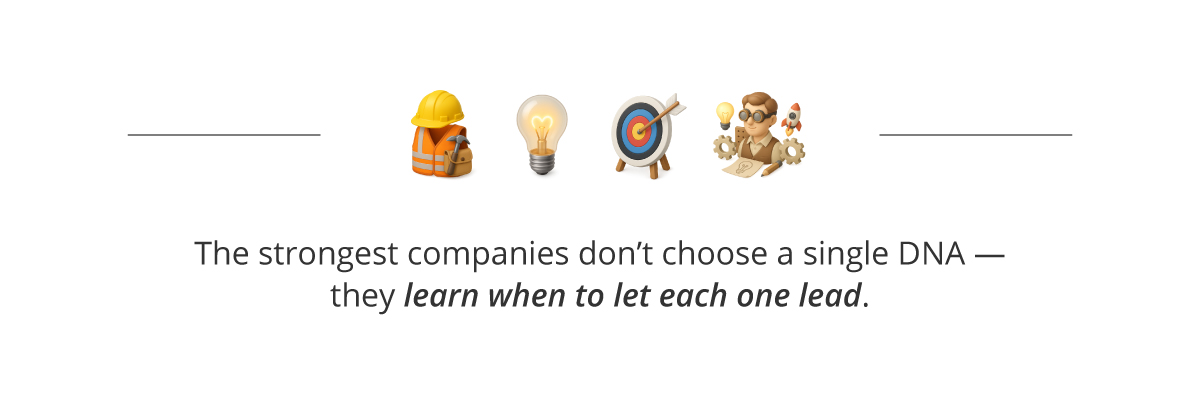
The pattern repeats: Innovators open doors, Builders make the structure solid, Specialists maintain credibility, and Opportunists keep the energy alive. The secret isn’t having all four at once — it’s knowing which one to lead with for the phase you’re in.
Startups need the daring of an Innovator and the hustle of an Opportunist. Scaling demands the Builder’s structure. Endurance depends on the Specialist’s consistency. Teams that understand this stop treating their differences as friction and start using them as design.
Conclusion: Finding Your Own Entrepreneurial DNA
Success leaves patterns. They’re not random; they’re relational.
When you know your own entrepreneurial DNA — and the mix surrounding you — strategy stops feeling like guesswork. You stop forcing growth that doesn’t fit your wiring. Your team stops fighting invisible battles about how things should be done.
If you missed the earlier pieces in this series, start with The Four Entrepreneurial DNAs Explained to find your core profile, then move to What Is the BOSI Framework? to see how those profiles interact inside a business.
Growth starts to feel natural again. Not because it’s easy, but because the right people are finally building in the way they’re built to build.
Further Reading
For readers who want to explore the stories behind the companies and founders mentioned in this article:
● Howard Schultz and Starbucks — Onward: How Starbucks Fought for Its Life Without Losing Its Soul (Howard Schultz, 2011).
● Reed Hastings and Netflix — No Rules Rules: Netflix and the Culture of Reinvention (Reed Hastings & Erin Meyer, 2020).
● Richard Branson and Virgin Group — Losing My Virginity: How I Survived, Had Fun, and Made a Fortune Doing Business My Way (Richard Branson, 2011).
● Sara Blakely and Spanx — “How I Built This: Sara Blakely, Spanx” — NPR Podcast, 2017 https://one.npr.org/?sharedMediaId=493169696:493311384
● Yvon Chouinard and Patagonia — Let My People Go Surfing: The Education of a Reluctant Businessman (Yvon Chouinard, 2006).
● Warren Buffett and Berkshire Hathaway — The Essays of Warren Buffett: Lessons for Corporate America (Warren Buffett & Lawrence Cunningham, 2015).
● Steve Jobs and Apple — Steve Jobs (Walter Isaacson, 2011).
● Elon Musk and Tesla/SpaceX — Elon Musk: Tesla, SpaceX, and the Quest for a Fantastic Future (Ashlee Vance, 2017).
● Phil Knight and Nike — Shoe Dog: A Memoir by the Creator of Nike (Phil Knight, 2016).
● Airbnb Founders — The Airbnb Story: How Three Ordinary Guys Disrupted an Industry, Made Billions … and Created Plenty of Controversy (Leigh Gallagher, 2017).
Paul Strobl, MBA, CPC
Owner of Confide Coaching, LLC
Paul is a Master Life Coach for GenX and GenY executives and business owners. Originally from Houston, Texas, he has been location independent for most of his adult life. He currently resides in the Rhodope Mountains of Bulgaria near the Greek border with his brilliant wife, 15-year-old stepson (officially adopted in 2021!) and a Posavac Hound rescue.
Paul is also a Certified BOSI Partner, Executive Coach, and Entrepreneurial DNA practitioner who has delivered BOSI-based workshops for MBA programs, accelerators, and leadership teams worldwide.