
Inspired by insights from Dr. Scott Eilers in conversation with Chris Williamson on the Modern Wisdom podcast.

You’ve done everything right. You’ve built a life that looks great from the outside — checked the boxes, met the goals, hit the milestones. You should feel proud. You should feel grateful. But what you actually feel is… not much at all.
The things that used to light you up now barely flicker. You go through your days competent, responsible, and successful, but emotionally flat. You’re not falling apart, and this isn’t a dramatic crisis. It’s something quieter. More confusing. A dull, persistent question you can’t shake: Why doesn’t this feel good anymore?
This isn’t laziness. It’s not burnout or depression either. What you’re feeling may be something psychologists have studied for decades, but that only entered the mainstream conversation more recently: languishing.
When organizational psychologist Adam Grant introduced the concept in his widely read New York Times article during the pandemic, it struck a nerve. He described languishing as the “neglected middle child of mental health” — a foggy, joyless state where you’re not in pain, but you’re not thriving either. Not in crisis, but not connected. The word gave shape to what many high-functioning people had quietly been experiencing for years.
For high achievers, languishing isn’t always triggered by chaos or failure. Often, it’s the cumulative result of competence: years of solving problems, leading others, staying on top of everything. You’ve kept going, but something vital has quietly gone missing.
This is what Dr. Scott Eilers calls a shift in your joy threshold.
Just like your brain can stop noticing the hum of a fan or the scent of a candle, it can begin tuning out emotional signals. Small moments that once made you feel alive — your morning coffee, a walk at sunset, even a meaningful conversation — start slipping past your awareness. Not because they’ve stopped being good, but because your internal bar for what counts as joy has risen without you realizing it.
When you live in a near-constant state of performance or pressure, your nervous system adapts. It takes more stimulation, more intensity, more something to feel the same emotional lift. You keep functioning, but joy quietly slips out of reach.
And that’s where the paradox begins. When the joy fades, your first instinct might be to work even harder, seek a bigger win, or raise the bar again. You start to believe the problem is that you’re not pushing hard enough.
But that’s not it. The real problem is that no one taught you how to recognize joy once it changes.
This article offers something different: five research-informed, psychologically grounded tools to help you reattune to joy. Some of them might seem counterintuitive. But they work.
Let’s begin by looking at what happens when we stop doing the things that once made us feel good, because we stopped expecting them to work.
The Emotional Prison
Once your joy threshold has shifted, the next challenge is subtle but significant: you stop registering joy even when it’s technically present. Life doesn’t feel bad — just dim. Achievements come and go without the internal reward. Interactions become polite rather than energizing. And over time, this flatness can start to feel normal, even inevitable.
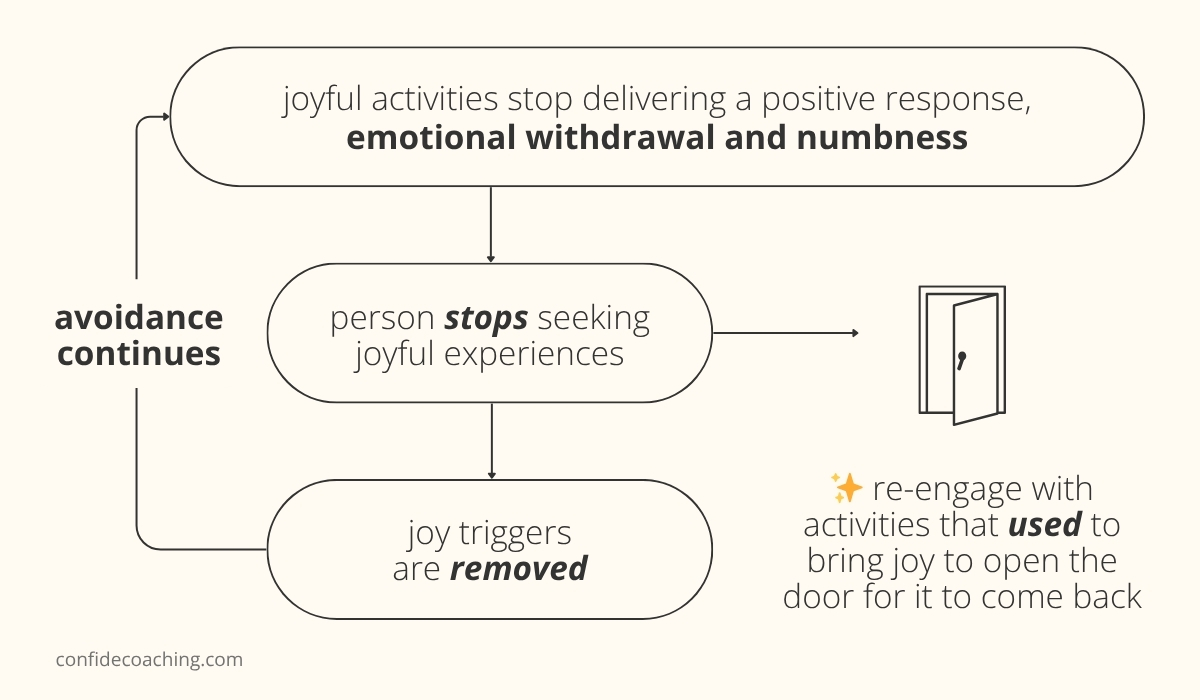
But it isn’t. According to Dr. Scott Eilers, this state isn’t a permanent condition — it’s more like an emotional holding pattern. He uses a striking metaphor: a self-made sensory deprivation tank. Not imposed from the outside, but built over time through withdrawal from the very things that once brought light into your day.
Here’s how it happens: when joyful experiences repeatedly fail to deliver a positive emotional response, many people unconsciously stop seeking them out. You stop texting your friend, cancel the weekend hike, and scroll instead of playing music or reading. You tell yourself there’s no point. But in doing so, you’re not just opting out of disappointment — you’re quietly removing all the possible entry points for joy to return.
And that’s the real trap. When your emotional responsiveness begins to come back — and it will — you won’t notice it. Not because you’re incapable of feeling, but because your life no longer contains the kinds of moments that could spark that feeling. You’re not locked in; the door is open. But if you never check it, you’ll stay inside.
This is why emotional numbness becomes self-reinforcing. You’re not stuck because joy has disappeared — you’re stuck because you’ve stopped creating chances for it to show up.
You don’t need to feel ready to invite joy back in. But you do need to keep the door unlocked. The smallest action — a walk, a phone call, a familiar song — can serve as a signal. Not that joy is guaranteed, but that it’s still possible.
And when it returns, you’ll want something in your life for it to land on.
The Trap of External Pleasure vs. Internal Fulfillment
Feel Good vs. Be Good
When joy goes missing, the natural impulse is to reach for something that feels good. A quick win. A hit of novelty. A distraction, reward, or indulgence. And for a moment, it might help. But there’s a difference between a mood boost and a meaningful shift in your emotional state.
Dr. Scott Eilers describes this as the difference between doing things that feel good and doing things that make it good to be you. The distinction is subtle, but it’s the foundation of sustainable joy.
Pleasure is reactive. It’s dependent on circumstance—on the outcome of a conversation, a successful project, the right kind of weather, or someone else’s approval. Fulfillment, on the other hand, is generative. It comes from alignment: from acting in accordance with your values, honoring your health, and doing what matters even when it’s hard.
The problem isn’t that pleasure is bad. It’s that if you build your emotional life solely around external sources of joy, you create a fragile system—one that crumbles when those sources become unavailable, unreliable, or ineffective.
Joy built on external validation is always at risk.
It requires the world to cooperate. And the world doesn’t always do that.
Internal fulfillment, by contrast, is more stable. When you focus on actions that strengthen your sense of integrity—whether that’s exercising, setting boundaries, reaching out to someone you care about, or finishing something you said you’d do—you create conditions that make it easier for joy to return.
This isn’t about giving up pleasure. It’s about anchoring it in something deeper. And it sets the stage for the five tools that follow—each designed to help you reconnect with joy not by chasing it, but by becoming someone who’s ready to feel it again.
Tool 1: Creating Opportunities for Joy
Show Up Even When You Feel Nothing
When you’re emotionally flat, joy can feel like a memory — something you used to access easily but now seems distant or unreachable. The mistake many people make in this state is waiting to feel good before they engage in joyful activities. But according to Dr. Scott Eilers, that’s the wrong order of operations.
The truth is: you won’t feel like doing the thing that might help you feel better. And that’s exactly why you need to do it.
This first tool is about reintroducing the conditions for joy to return — not because you feel ready, but because, as we already touched on, joy needs somewhere to land. That means intentionally choosing to re-engage with the activities that used to make you feel good, even if they don’t work right away.
Call the friend. Go to the park. Put on the playlist. Take the walk.
And here’s the critical shift: don’t expect it to feel great in the moment. In fact, assume it won’t. Emotional responsiveness doesn’t always return in real-time. But by doing the thing anyway, you give yourself something to look back on later — a memory, a sense of movement, a reminder that you’re still in the game.
Joy often returns in hindsight. You may not feel it while it’s happening, but looking back, you’ll notice it mattered. You’ll feel grateful you did it — even if, at the time, it felt flat.
Think of this tool as emotional scaffolding. You’re not rebuilding joy from scratch. You’re creating the structure for it to find its way back. It’s less about feeling better instantly and more about staying open, staying in motion, and refusing to let numbness become your new baseline.
By choosing to act — despite the absence of reward — you’re sending a powerful message to your nervous system: This still matters. I still care. And I’m making space for joy, even if I can’t feel it yet.
Tool 2: Stacking Joy with Achievement That Aligns
Make Joy Earn Its Meaning
When you’re emotionally flat, it’s tempting to chase the kind of joy that’s immediate — comfort food, a dopamine hit, a spontaneous treat. But here’s the catch: when your joy threshold has shifted, small pleasures that once sparked delight now barely register. A good meal, a favorite movie, even a spontaneous outing may feel strangely muted.
This is where many people get stuck. They try to pile on more of the same — more leisure, more treats, more distraction — hoping one of them will finally break through. But what Dr. Scott Eilers points out is that stacking joy on joy rarely works when your threshold is elevated. What does work is combining joy with something more enduring: a sense of meaning or progress.
Achievement — especially when it’s tied to your values — is what gives pleasure context. It grounds it. It tells your brain, this matters, not just this feels good.
And this is where the idea of “feel good” vs. “good to be you” becomes essential.
“Feel good” experiences are short-term and sensory: they light up the moment but often fade quickly. They depend on conditions being just right — your energy level, your mood, your environment. And when your emotional system is already dull, these hits often don’t land.
But “good to be you” experiences come from alignment. They emerge when you do something that reinforces the kind of person you want to be: finishing the workout, sticking to a promise, reaching out when it’s easier to stay silent, completing a hard task you were tempted to delay. These moments may not feel euphoric in real time — but they leave a trace. They build self-trust. They feel clean, solid, earned.
When you stack a joy-producing activity on top of a values-driven achievement, you create the conditions for deeper emotional impact. You’re no longer trying to distract yourself out of numbness — you’re building the kind of identity that makes joy easier to access.
Pleasure becomes meaningful when it’s attached to who you’re becoming — not just what you’re consuming.
This is how you lower the joy threshold: not by chasing harder, but by anchoring joy to the person you respect being.
In this way, joy stops being a fragile feeling you have to capture. It becomes a byproduct of becoming someone it’s good to be.
Tool 3: Finding Loopholes of Joy
Use What Still Works — Even If It’s Small
When most things feel flat, it’s easy to assume everything is broken. But that’s rarely true. Even in the lowest emotional states, there are usually one or two things that still spark something — however faint. A particular food. A song. A person you don’t have to pretend with. A familiar route you like to walk.
Dr. Scott Eilers calls these “loopholes of joy.” They’re not dramatic. They’re not consistent. But they still get through.
In a period of emotional dullness, these loopholes can become your lifeline. They offer proof that your emotional system isn’t gone — it’s just quieter, and more selective. You may not feel lit up by the things that used to work, but some part of you still responds to something. That matters.
Start by identifying what still reaches you:
- Is there one person you can reach out to without it feeling draining?
- A food that still brings a flicker of comfort or nostalgia?
- A hobby, show, or setting that feels strangely safe or easy?
These are your emotional footholds. Use them — not to escape reality, but to stay tethered to it.
There’s a caution here too: loopholes can narrow your world. If you’re only doing the same one or two things over and over — eating the same comfort food, talking to the same person, watching the same series — it can become a rut rather than a resource. The goal isn’t to depend on loopholes forever, but to let them bridge the gap until your capacity for wider joy returns.
Loopholes are not indulgences — they’re anchors. They remind you that your emotional system is still intact. And they help you stay connected, even when your range of joy feels limited.
Use them wisely. Let them hold you up — but not hold you back.
Tool 4: Apathyception — Outsmarting Apathy
Reframe Your Apathy Before It Ruins You
There’s a moment that comes after the numbness, after the disappointment, after the flat effort to feel better has failed — when you begin to notice your own apathy.
Not just “I don’t care.”
But “I don’t care — and now I care that I don’t care.”
Dr. Scott Eilers calls this moment apathyception — when your apathy becomes self-aware. It sounds like, “Why am I like this?” “Nothing matters.” “Even the stuff I love feels hollow.” And then, quietly, “Is something wrong with me?”
It’s here that a powerful shift becomes possible — not through motivation, but through mental leverage.
You don’t need to wait for energy or passion to come back. You can intervene at the level of thought. The reframe is simple, and oddly freeing:
“I can choose not to care about the fact that I don’t care right now.”
This is how you out-apathy your own apathy.
It’s not denial. It’s a form of detachment that gives you room to move. Instead of spiraling in self-judgment or retreating from life because you “should” feel more, you simply accept the apathy — and bypass it. You say, So what if I’m not feeling it today? I’m still going to do the thing.
This reframing breaks the perfectionist belief that every meaningful action has to come with a meaningful feeling. It separates your values from your mood.
And here’s where this connects to Tool 2: you’re not acting out of inspiration — you’re acting from identity. You’re choosing to keep doing the things that make it good to be you, even if they don’t feel good right now. That choice, small as it seems, is a declaration: I still know who I want to be.
Apathy doesn’t have to be argued with or overcome — it can be outmaneuvered. You don’t need to care more. You just need to stop letting your current level of caring dictate your next move.
This mental sleight of hand is subtle but powerful. It keeps you moving without pretending everything is fine. And sometimes, that’s exactly what breaks the spell.
Tool 5: Reverse Engineering Unhappiness
Use Inversion Thinking to Find What Actually Matters
When you’re stuck, clarity doesn’t always come from asking, What should I do? Sometimes the better question is:
“What would I do if I wanted to make this worse?”
It sounds backwards, but this technique — known as inversion thinking — can unlock surprising insight. Instead of brainstorming how to feel better (which often leads to vague or overwhelming answers), you make a list of how to feel worse. Tangibly. Deliberately. With detail.
It might look like:
- Stay up all night scrolling.
- Avoid every person who makes me feel understood.
- Stop exercising completely.
- Eat only junk and caffeine.
- Say yes to everything I don’t want to do.
- Keep ruminating on what’s missing.
You’ll probably surprise yourself with how clear the list is — and how accurate. That’s because our brains are often better at spotting patterns of dysfunction than identifying ideal solutions. But here’s the power of this approach: once the list is complete, flip it.
Now you have a custom blueprint for what not to do — and, more importantly, a starting point for what to do instead.
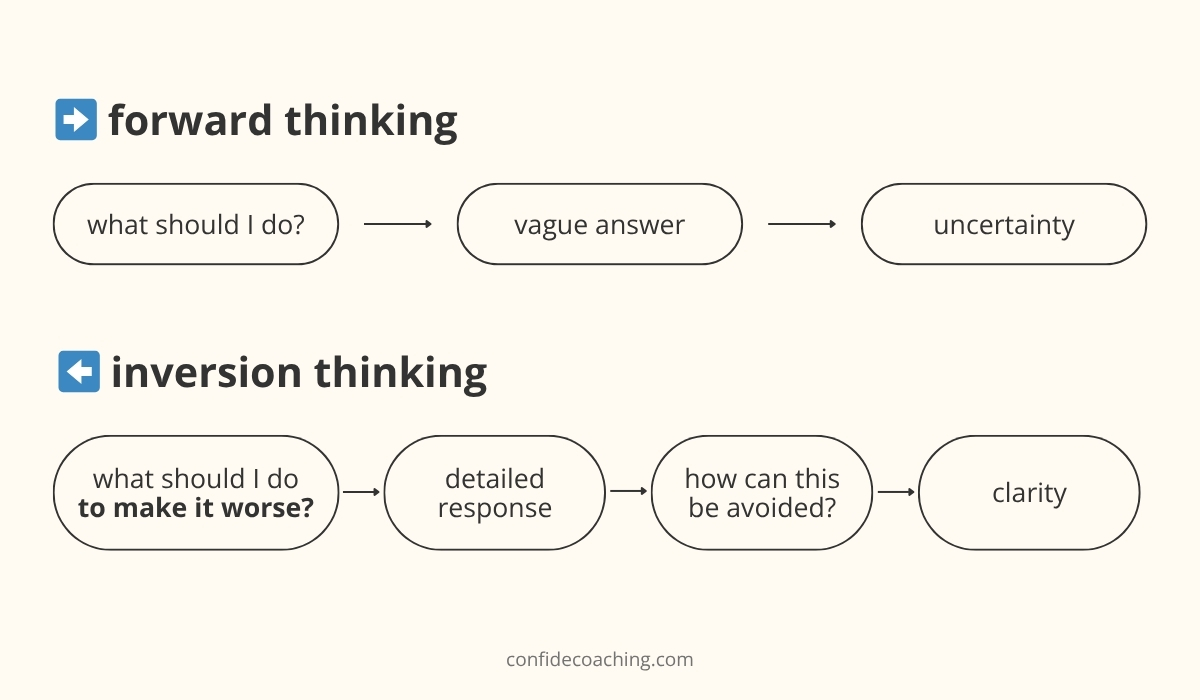
Instead of trying to build a perfect life from scratch, you’re reverse-engineering a better one by removing what drains you.
This tool bypasses the stuckness that comes with pressure to “get it right” and replaces it with something pragmatic and grounded: the next right thing is simply the opposite of what you know would make things worse.
You don’t always need clarity about what will help. You just need clarity about what will harm — and then do the opposite.
It’s simple. It’s honest. And it works.
Sometimes the fastest way to move forward isn’t by chasing joy — it’s by steering deliberately away from what erodes it.
Rebuilding Joy from the Inside Out
The Real Foundation of Emotional Well-Being
Before you can reconnect with joy, you have to ask a more basic question: Is your system even capable of feeling it right now?
This is something I explore with many of my coaching clients. Before we dive into mindset shifts, reframing beliefs, or setting boundaries — what people often expect from life coaching — I start with a different set of questions:
- How are you sleeping?
- What are you eating, and how does it make you feel two hours later?
- Are you moving your body regularly in a way that gives you energy?
- Do you have time in your day when your nervous system gets a break, or are you always “on”?
Because here’s the truth: if your biology is depleted, your psychology won’t work the way you want it to.
Dr. Scott Eilers makes this clear in the Modern Wisdom podcast, outlining what he calls the order of operations for helping yourself: biological → psychological → social. This isn’t just theory, it’s practical. You cannot feel emotionally alive when your system is in survival mode.
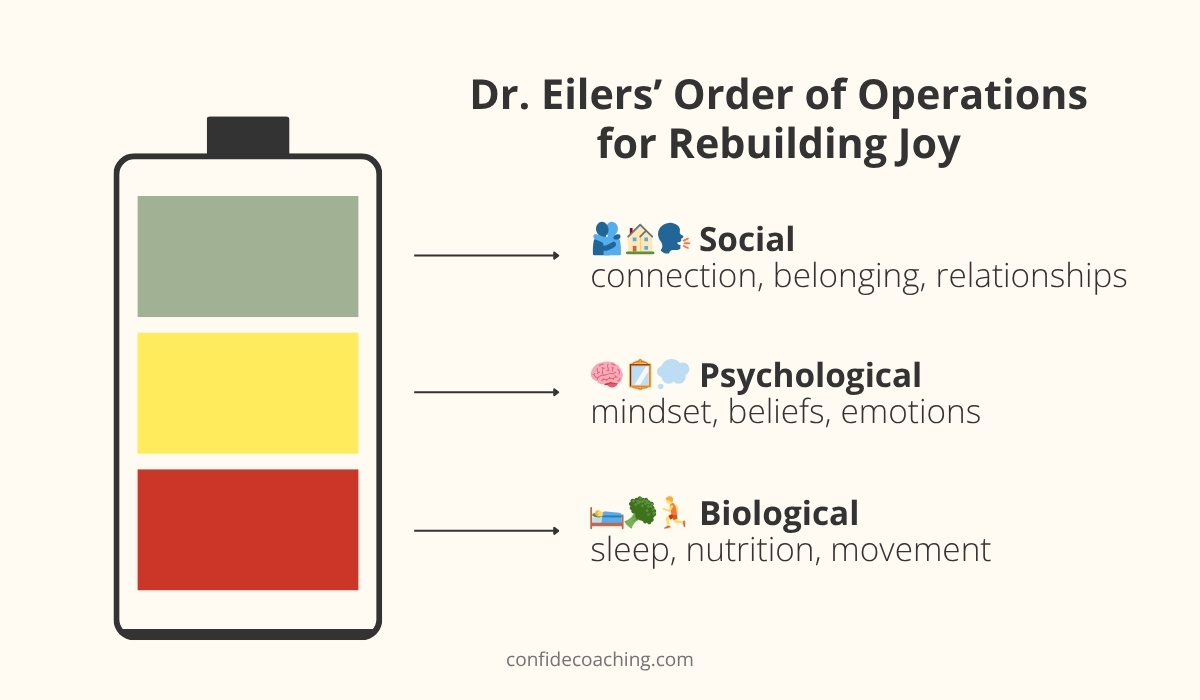
1. Biological foundation
Your brain doesn’t float in a vacuum. It lives inside your body, and that body needs fuel, rest, and movement to support stable mental and emotional functioning. Without them, the brain does what it’s designed to do under stress: conserve resources.
Eilers uses a powerful metaphor: think of your brain as a power grid. When energy is limited, it starts shutting down nonessential systems. Creativity, emotional range, motivation, and joy? All of those go dark first. The grid reroutes energy to the basics: keep breathing, keep moving, keep functioning.
If you’re not sleeping deeply, if your diet is spiking and crashing your energy, if your body is static and overstimulated, your emotional bandwidth narrows. You start running on minimums. Joy doesn’t disappear, it just gets deprioritized.
Start here:
- Prioritize consistent, quality sleep.
- Eat in a way that stabilizes, not just satisfies, your energy.
- Move your body in ways that stimulate oxygen flow and reset your nervous system.
- Interrupt chronic stress with deliberate recovery: mindful breaks, intentional gratitude, and slow breathing.
2. Psychological mastery
Once the body has what it needs, your internal dialogue becomes the next layer of support — or sabotage.
The way you speak to yourself matters. Not just the thoughts you think, but the tone you think them in. Are you harsh? Demanding? Dismissive? Many people maintain external success while internally speaking to themselves in a way they’d never speak to anyone else.
This inner climate directly shapes your emotional world. A self-critical mind creates a background hum of stress and pressure that flattens your ability to feel pleasure. A more compassionate and reality-based voice, by contrast, creates emotional space — and builds trust.
How you speak to yourself shapes your emotional landscape. Your nervous system listens. Your thoughts are not just private commentary; they are inputs into how safe, resourced, and worthy you feel.
Start small:
- Catch unhelpful mental loops like “This shouldn’t be so hard” or “I’m not good at this.”
- Replace them with neutral, grounded reframes: “This is hard because it matters.”
- Talk to yourself like someone you’re responsible for protecting — not managing.
3. Social connection
Finally, no amount of internal work fully compensates for a lack of meaningful human connection. We are wired to co-regulate — to experience joy, ease, and safety through others. Yet when we feel flat or numb, social withdrawal is often the first casualty.
The problem is: isolation reinforces emotional dullness. Even a minimal, low-pressure connection — texting a friend, sharing a moment with a partner, spending time with someone who requires nothing from you — can restore perspective and rekindle feeling.
This doesn’t require a full social calendar. It requires intention.
- Reconnect with someone who feels emotionally easy to be around.
- Invite small moments of warmth, not just conversation.
- Prioritize depth over quantity. A 10-minute honest exchange can shift your entire nervous system.
Think of social connection as part of your emotional hygiene. It’s not just “nice to have” — it’s a core ingredient in your ability to feel joy and meaning.
Rebuilding joy isn’t about chasing better feelings. It’s about restoring the conditions that allow joy to return. And those conditions start with the basics: body, mind, connection.
When you give your system what it needs to function, joy doesn’t have to be forced. It finds its way back in.
Sustainable Joy Through Consistent Habits
Small Inputs, Big Emotional Shifts
Once you’ve restored the biological, psychological, and relational foundations for joy, the next step is learning how to sustain it, not through intensity, but through rhythm.
The mistake many people make is thinking joy has to arrive in bursts: vacations, breakthroughs, peak moments. But the truth is, real joy is often cumulative. It builds slowly, reinforced by small, consistent choices made daily.
That’s why habits matter, not because they’re flashy, but because they create emotional stability. The right routines give your nervous system something to trust: nourishment, movement, sleep, social contact, time to reflect.
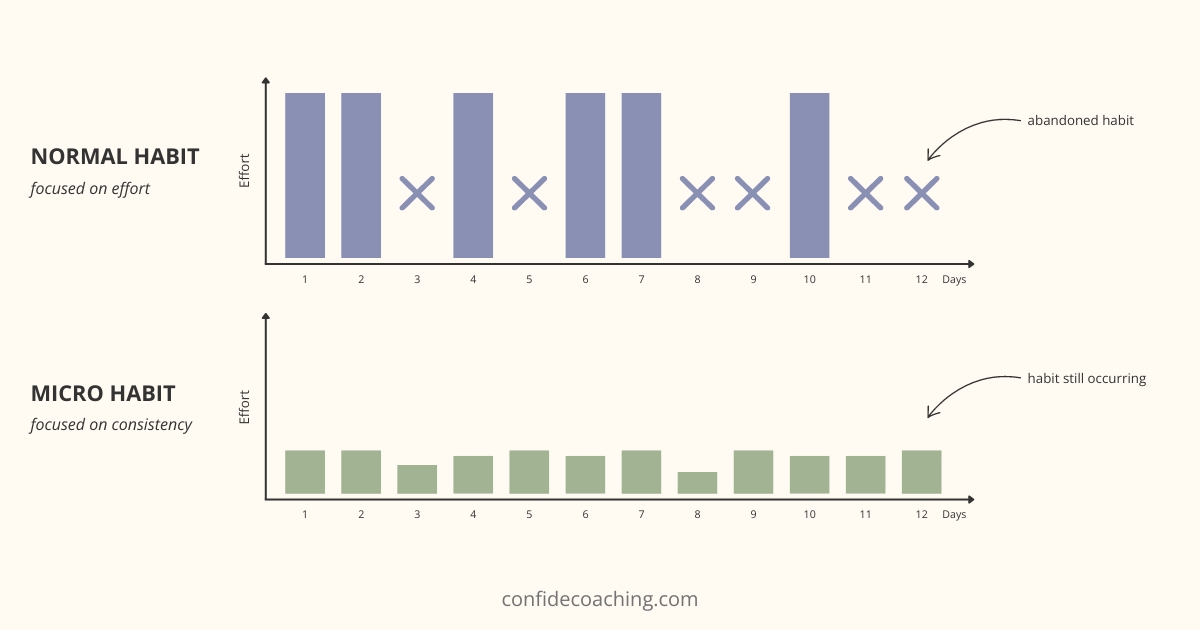
You don’t need perfect habits. You need dependable ones.
- Morning light and movement to reset your circadian rhythm.
- A regular wind-down ritual to support deep sleep.
- One nourishing meal a day that doesn’t come from a screen-lit rush.
- A check-in with someone who reminds you who you are.
- One moment of stillness where nothing is expected of you.
True joy isn’t about doing more, it’s about doing fewer things, more consistently, that make life feel inhabitable.
These habits become anchors. They prevent emotional backsliding. They lower your stress baseline. And most importantly, they create the ongoing structure for joy to become part of your daily life, not something you chase, but something you cultivate.
Conclusion: Making Life Good to Be You
Joy Doesn’t Just Return. It’s Rebuilt.
If you’ve lost access to joy, it doesn’t mean something’s wrong with you. It means your system is asking for different conditions.
Throughout this article, we’ve explored why joy disappears, not because you have lost motivation or because you need bigger achievements, but because high-functioning lives often come at the cost of emotional bandwidth. You’ve been solving, producing, and showing up, but not necessarily paying attention to how you feel along the way.
The good news is: joy can return. Not all at once, and not always how you expect, but it can come back.
And not through pushing harder.
Not through achieving more.
But through rebuilding your foundation. Through anchoring joy to identity, not outcomes. Through showing up even when it’s flat. Through outsmarting your own apathy. Through noticing the one thing that still makes you feel like you, and doing it again.
When joy becomes tied to who you are, rather than what happens to you, something shifts.
You stop chasing moments that feel good, and start creating a life that feels good to be in.
That’s not just emotional recovery. That’s transformation.

Paul Strobl, MBA, CPC
Owner of Confide Coaching, LLC
Paul is a Master Life Coach for GenX and GenY executives and business owners. Originally from Houston, Texas, he has been location independent for most of his adult life. He currently resides in the Rhodope Mountains of Bulgaria near the Greek border with his brilliant wife, 15-year-old stepson (officially adopted in 2021!) and a Posavac Hound rescue.
Paul is also a Certified BOSI Partner, Executive Coach, and Entrepreneurial DNA practitioner who has delivered BOSI-based workshops for MBA programs, accelerators, and leadership teams worldwide.
Reference
Eilers, S. (2025, July 12). Why does life sometimes feel emotionally numb? [Video]. Modern Wisdom with Chris Williamson. YouTube. https://youtu.be/BUp5YxPe2Qw?si=6Hr83AyV1N5-Ep-w