
When the provider phase ends and the questions begin
Have you ever caught yourself thinking, Is this it?
Not in a dramatic, quit-your-job-and-buy-a-motorcycle way. (Though if you do buy a motorcycle, get the right gear. Gen X knees aren’t what they used to be.)
More like a quiet moment late at night, or on a Sunday afternoon when the week hasn’t started yet. You look at your life and notice something awkward: you did what you were supposed to do. You built a career. You provided. You handled responsibility like a reasonably competent adult.
So why does it still feel unfinished?
Most people don’t say this out loud because it sounds ungrateful. You’re supposed to be happy now. You followed the instructions. You checked the boxes. You even laminated some of them, for Christ’s sake. Very responsible of you.
Somewhere along the way, satisfaction was supposed to appear like a prize at the bottom of a cereal box. Turns out the prize was just a plastic decoder ring that doesn’t decode anything useful.
Instead, there’s a question.
This isn’t a crisis. It’s a transition.
It’s what happens when the first half of life did its job and the second half hasn’t received a new job description yet.
The Provider Phase (and What Happens When It Ends)
For a long time, identity came from being useful. You were the one who made things happen. People counted on you. Bills got paid. Problems got solved. Chaos stayed mostly outside.
That role has a certain logic to it. Work hard, keep things stable, repeat. It’s demanding, but it’s clear. You know why you’re tired.
Then something changes. Not all at once. Just gradually, the way Blockbuster disappeared.
The kids grow up and need you in a more abstract way. The business becomes less fragile. Financial pressure eases enough that you’re no longer living in survival mode.
What you gain is space. What you lose is friction.
Without constant urgency, your mind starts asking questions it didn’t have time for before. Questions like, “Is this what I want to keep doing?” and “What is all this actually for?” and “When did Nirvana become Classic Rock?”
When your worth has been tied to output for decades, extra space can feel suspicious. You start wondering if something is wrong. Usually, what’s wrong is that nothing is on fire.
When you stop being needed the same way, you start asking who you are without the urgency.
The Hidden Grief of ‘Having Succeeded’
There’s a strange kind of grief that shows up when things go well. It doesn’t show up in a black outfit carrying a casserole. It shows up wearing business casual and asking polite questions about your long-term plans.
Some of it comes from paths not taken. Some of it comes from realizing how much of your energy went into survival instead of expression. You were busy building something stable, so other parts of you waited quietly in the corner, like well-behaved children waiting for the sermon to end.
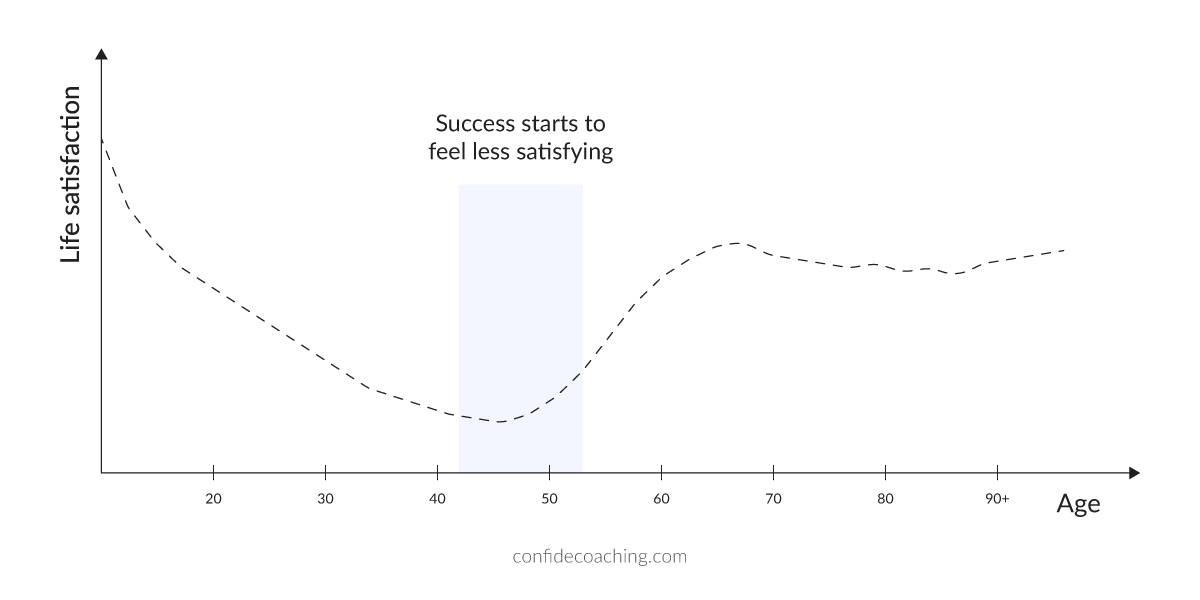
Professional athletes deal with something similar when they retire. Their days were organized around training, competition, and recovery. Then the structure disappears. The scoreboard vanishes. The body stops being the main focus of every day.
Even when retirement is voluntary, it can feel strange.
Ever seen a former CEO walk through their old office? No one snaps to attention. Meetings keep going. The place doesn’t flinch. It’s like they were a spoonful of water lifted out of the ocean — and the surface closed up behind them.
It’s humbling. Also clarifying. Turns out you weren’t the sun. You were more like… a particularly bright lamp.
The problem isn’t that the game ended. The problem is that the game was your identity.
For high achievers in business, the pattern is familiar. The company doesn’t need you the way it once did. The family no longer revolves around you. The arena that made sense for twenty years suddenly feels small.
The grief isn’t about failure. It’s about finishing one game and realizing nobody told you what the next one was.
The Sunk Cost Trap (and the ‘I’m in the Right Place, But…’ Group)
When this question shows up, people assume it means they want out. Sometimes that’s true. Sometimes it isn’t.
There are two common camps here.
One group knows they want a change but feels stuck because of how much they’ve invested. Years. Skills. Reputation. A coffee mug that reads ‘World’s Okayest Boss’ that you got as a joke but actually hurt your feelings a little.
The other group is in a situation that looks good on paper. Right industry. Decent freedom. Reasonable success. And yet, something feels off. Not broken enough to leave. Not satisfying enough to ignore.
Both groups run into the same thought pattern: “I’ve put too much into this to change now.”
That sounds sensible, and it’s very much in line with Newton’s First Law of Motion. But it just isn’t very helpful.
Time already spent doesn’t obligate you to keep going in the same direction. Skills don’t trap you in one identity. Comfort doesn’t mean growth is finished.
You’re allowed to evolve even if nothing is technically wrong.
The real question isn’t whether you should blow things up and walk away in slow motion like an ’80s action hero. It’s whether the person who built this life is still the right person to be in charge of it.
The Health Foundation
Before any of this gets too philosophical, something practical matters: you won’t be able to give your kids unsolicited parenting advice if you’re dead.
Meaning assumes energy. Direction assumes capacity. Redesign assumes runway.
High achievers are good at postponing health. It’s treated like a hobby you’ll return to when life calms down, which is adorable optimism if you think about it. Right up there with “I’ll start putting away more money for retirement” and “I’ll definitely floss more after this dentist appointment.”
If you’re constantly tired, inflamed, or running on coffee and willpower, the question “What should I do with the rest of my life?” turns into background noise. It’s hard to hear anything useful from a depleted system.
This isn’t about extremes. It’s about the basics that have proven to work quietly in the background: sleep, movement, nutrition, and recovery. Not perfection. Just consistency.
We’re talking “don’t actively sabotage yourself” levels of effort, not biohacker Instagram influencer nonsense.
If you don’t have your health, the rest of this conversation is mostly academic.
High Achievers Still Need to Achieve
There’s an idea that midlife is when ambition should fade and everyone should start gardening. Naked gardening, if you believe the internet. (Don’t believe the internet.) Gardening is fine. Ambition is too.
Drive doesn’t disappear just because the calendar changes. What changes is what it points at.
Earlier in life, achievement was tied to survival and responsibility. You needed to win because the stakes were real. Over time, those stakes shift. The mortgage is lighter. The kids don’t need daily supervision. The business doesn’t wobble every quarter.
The old measures stop making sense. Quarterly earnings feel increasingly absurd when you’re wondering how many Thanksgivings you have left with your parents. You need a new set of personal KPIs.
That’s why this feels confusing. You still want a challenge. You just don’t want that one anymore.
This isn’t a crisis. It’s a shift in where achievement needs to point. Winning needs to be re-defined.
The Second-Half Pivot (Without Extremes or Escape Fantasies)
When people hear “second half of life,” they imagine dramatic reinvention. Quitting. Selling everything. Moving to Costa Rica. Becoming a completely different person with a backyard cold plunge, a podcast about consciousness, and a suspiciously vague LinkedIn bio that says you’re “exploring new opportunities.”
That happens sometimes, but most people don’t need a new life. They need a new challenge that fits who they are now.
For some, that means a different role in the same field. For others, it’s building something alongside what already exists. Like a side project that isn’t just contemplating a side project. Sometimes it looks like teaching or mentoring. Sometimes it’s returning to an interest that got shelved when survival was more urgent.
Reinvention doesn’t have to be dramatic to be real. It can be parallel, layered, and experimental.
I don’t expect people to uproot their lives or change continents the way I have. That was my path, not universal advice. I’ve helped clients make big moves when that’s what they wanted. I’ve also helped many stay where they are and change how they relate to their work, their relationships, and their time.
The second half of life isn’t about escape. It’s about authorship.
Most people don’t need a new identity. They need a truer relationship with the one they already have.
Self-Assessment: Where Are You, Really?
These questions aren’t here to diagnose you. They’re here to give you a clearer signal.
Think about them slowly.
- If nothing changed for the next ten years, how would that feel in your body?
- Are you tired, or are you bored?
- What part of you hasn’t had airtime in years?
- Do you want relief, or do you want a new game?
- When you imagine the next chapter, do you feel pressure or curiosity?
- Are you staying because it fits, or because it’s familiar?
People usually land in one of four places:
- Comfortable but restless
- Successful but constrained
- Quietly disengaged
- Ready for redesign
None of these are diagnoses. They’re starting positions.
If you’re thinking “Is this entire guide just describing depression?” — fair question. But depression doesn’t usually come with a clear sense of what you actually want to do. This does.
What Comes Next
For some people, that looks like a career pivot. For others, it means going deeper into work they already do, but in a way that feels more intentional. Sometimes it’s building something small that matters instead of something big that only looks impressive.
There’s no universal answer. But there is a pattern: people who feel best about this phase are the ones who design it based on who they are now or who they want to become, instead of letting momentum make the decisions for them.
One Last Thing
I care about this topic because I’ve lived it. I’ve built things, walked away from things, and helped other people do both. I don’t believe that there’s one correct path. I do think that there’s a wrong one: pretending this question isn’t there when it is.
This guide isn’t for people who want a motivational speech. It’s for people who want to think clearly about what’s next and build something that fits the person they’ve become (or want to become).
If this resonated, that’s your signal. If it didn’t, you probably clicked the wrong link. Or you’re a Millennial who wandered in here by accident. Hi.
You don’t need to panic. You don’t need to blow anything up. You just need to stop letting inertia drive the bus.

Paul Strobl, MBA, CPC
Owner of Confide Coaching, LLC
Paul is a Master Life Coach for GenX and GenY executives and business owners. Originally from Houston, Texas, he has been location independent for most of his adult life. He currently resides in the Rhodope Mountains of Bulgaria near the Greek border with his brilliant wife, 15-year-old stepson (officially adopted in 2021!) and a Posavac Hound rescue.
Paul is also a Certified BOSI Partner, Executive Coach, and Entrepreneurial DNA practitioner who has delivered BOSI-based workshops for MBA programs, accelerators, and leadership teams worldwide.