

Your phone buzzes. “Can you jump on this now?” You type, “Not possible.” They read, “Not willing,” and the thread turns sharp. In a meeting, a sigh undoes your words. At home, “Are you late again?” turns into a courtroom witness stand. With a teenager, “Where were you?” meets “Why do you always assume the worst?” and doors close, literally.
The problem is not only the conflict; it’s the escalation that steals the next chance to talk. As Jefferson Fisher explains in The Next Conversation: Argue Less, Talk More (2025), real change happens in the next conversation. In my life coaching practice, I help clients put that idea to work: self-regulate, set clear boundaries, ask one curious question, then review what helped so the door stays open at work and at home.
This article gives you a phrase-first playbook built on Fisher’s three-part system and lessons from coaching executives and individuals, as well as my own parent-teen talks.
The Mindset Shift: Don’t “Win” the Argument, Win the Relationship
Before you even reach for tools, you need a different target. Under stress we keep score. We try to win, which makes the other person defend, attack, or shut down. You might get the last word today and lose tomorrow’s talk. When people feel unsafe, they stop bringing things up or give half-answers. That’s the dead end.
Use a new scorecard: lower defensiveness, clearer boundaries, and willingness to keep talking. You’ll hear calmer voices and fewer repeats. Each person can say one clean line about limits, like “I cannot do Friday. I can do Monday.” You leave with one next step on the calendar or in a text.
With this mindset in place, Fisher’s framework has something to land on. He outlines three simple but powerful moves: say it with Control, say it with Confidence, and say it to Connect. Let’s take them one at a time.
Fisher’s Three-Part System
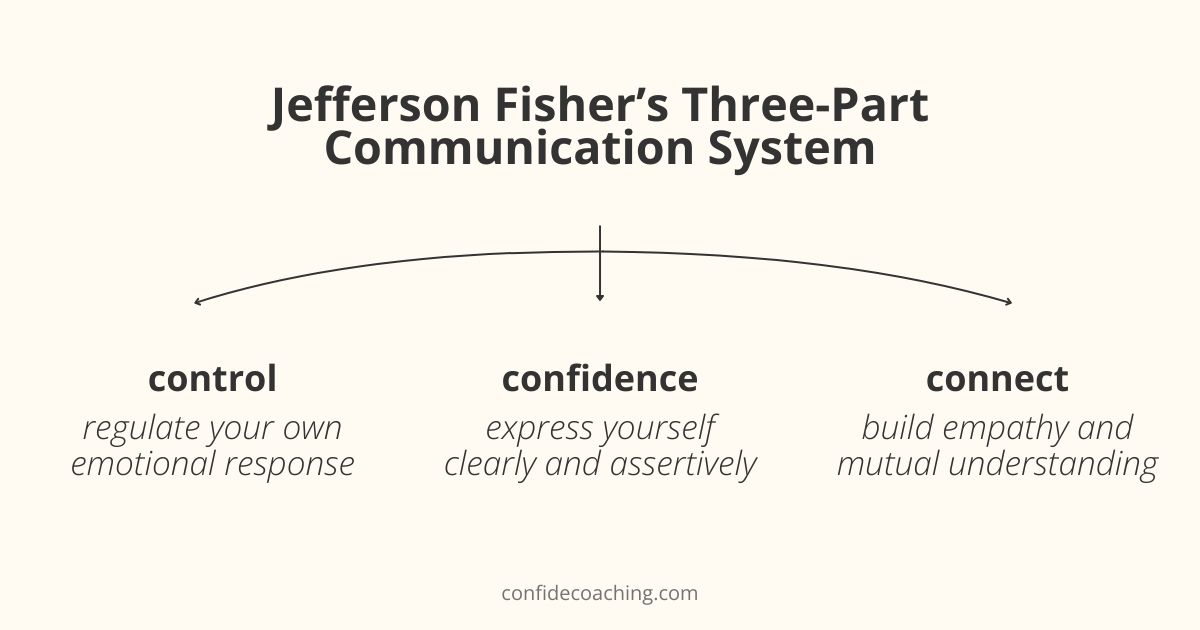
1. Say it with Control
When a conversation heats up, your body speeds up too. Your heart rate rises, your words come faster, and before you know it you’ve matched the other person’s intensity. This is where misinterpretation and escalation take over. Fisher’s first move is Control: regulate yourself before you speak so you don’t mirror their heat.
How to do it:
Take one breath. Slow your rate. If the moment is wrong, name the lane. “I’m not ready to answer. Give me an hour.” “Let’s park this until after the meeting.” Do a quick heat check: “Am I here to vent, to fix, or to understand?” If you’re venting, step away. If you want to fix or understand, say that out loud.
Try this:
“I want to get this right. Give me a second.”
“I can talk, but not in this tone. Let’s reset.”
“I hear the urgency. I need ten minutes to think, then I’ll respond.”
Why it helps:
Control lowers the temperature so meaning can travel. When you slow down and set scope, you remove guesswork about timing and tone. People feel less attacked, which keeps the door open for the next talk.
2. Say it with Confidence
Once you’re steady, the next hurdle is clarity. Many of us over-explain, pile on reasons, or soften so much we lose meaning. Fisher’s second move, Confidence, is about saying less but meaning more.
How to do it:
Use this frame: Boundary + brief reason + option. “That won’t work for me. I can do Tuesday at 2.” “I don’t lend money to friends. I’m happy to help you think through other options.” Define, don’t defend: one clear line is enough. Frame the goal at the start: “My aim is a plan we can both keep.” Then stop.
Try this:
“I’m not agreeing to that timeline. Here’s what I can commit to.”
“I hear your point. My decision is no.”
“Yes to the deliverable, no to Friday. Monday draft, final Wednesday.”
Why it helps:
Clear words shrink confusion. When you define instead of defend, the conversation moves from approval-seeking to problem-solving. The other person may not love your answer, but they can work with it. Confidence also protects your energy because you’re not chasing every objection.
3. Say it to Connect
Even with control and clarity, conversations can stall if the other person doesn’t feel understood. That’s why Fisher’s third move is Connection: showing you’ve heard them before you try to persuade.
How to do it:
Start with a curious question: “What’s the main concern for you?” or “What would make this feel fair?” Reflect back one line without conceding: “So timing is the issue. You want fewer last-minute changes.” Align on a shared outcome: “We both want this launch to succeed. Let’s protect quality and sanity.” If needed, steelman: restate their strongest argument before adding your own.
Try this:
“Fair point. What would good look like from your side?”
“We see it differently, and that’s okay. Here’s where I am.”
“If I say it back: you felt blindsided by the change. I wanted to keep momentum. Let’s set a rule for next time.”
Why it helps:
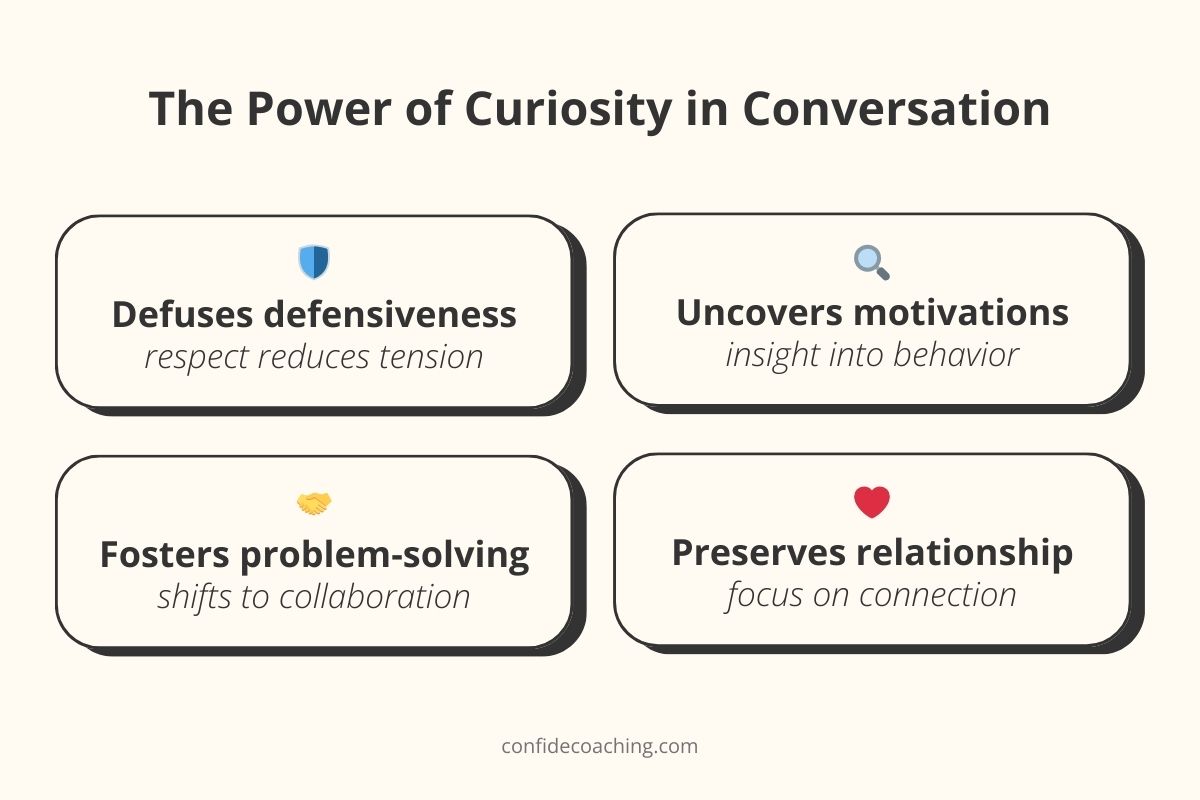
Curious questions and reflections reduce defensiveness. A shared outcome points the conversation toward solutions instead of blame. Connection makes the next conversation possible.
Putting the Three Together
Control sets the tone. Confidence sets the terms. Connection keeps the bond intact. In practice, they often flow in sequence:
- Control: “Give me a second. I want to get this right.”
- Connect: “It sounds like late changes are the problem. What would fix that for you?”
- Confidence: “Here’s what I can do by Monday. If we need Friday, we must drop A or B.”
Use that rhythm at work, at home, and with your teen. You’ll argue less, talk more, and protect the next conversation.
Pick Your Battles: Not Every Bait Deserves Your Energy
Not every conflict deserves airtime. Part of aiming for the next conversation is knowing which ones to skip. Fisher suggests filtering by four factors: relationship importance, stakes, timing, and your state.
Engage now when the stakes are high and both of you can slow down. Schedule later when it matters but the timing or your energy is off: “This matters. Let’s talk at 3.” Disengage when it’s bait or scorekeeping: “Not helpful right now. I’m stepping out.”
Choosing the right moment protects trust and preserves your energy for the talks that matter most.
The 60-second Reset for Heated Moments
Sometimes you don’t get to choose. The heat is here, now. For those moments, Fisher teaches a four-step reset you can run in under a minute:
- Breath and posture. Two slow breaths. Unclench your jaw. Plant both feet.
- State your purpose. “My goal is to solve this together.”
- Ask one curious question. “What matters most for you right now?”
- Set a boundary or next step. “We have ten minutes now, then we’ll schedule the rest,” or “Let’s pause and pick this up at 3.”
Memorize this sequence for meetings or family talks. It’s your emergency brake.
Phrase Bank: Plug-and-Play Lines for Common Conflicts
Even with a framework, finding the right words in the moment can feel impossible. The key is to think in the rhythm of the 60-second reset: state your purpose in one line, ask one curious question, and finish with a boundary or next step.
How to Craft a Curious Question
Curious questions are the engine of connection. They lower defensiveness by shifting the focus from arguing positions to understanding priorities. Unlike testing questions (“Can you commit by 7?”) or loaded ones (“Don’t you think you’re overreacting?”), a true curious question seeks clarity without judgment.
Three rules for crafting one:
- Neutral wording — no blame, no verdict hidden inside.
- One focus at a time — avoid stacking multiple questions together.
- Future- or priority-oriented — ask what matters, what helps, or what risk they’re trying to avoid.
Quick stems to borrow:
- “What matters most to you right now?”
- What would a good outcome look like?”
- “What feels unfair from your side?”
- “What one change would help most?”
At Work
- Purpose: “My goal is a plan we both can keep.”
- Curious question: “What’s the most important priority here for you?”
- Boundary/next step: “Let’s park the rest and return to the agenda. I’ll reply at 3; if it’s urgent, call.”
Complete reset:
“Let’s stay focused on the agenda so we finish on time. What’s the most important piece for you right now? I’ll follow up at 3, or we can schedule a quick huddle tomorrow.”
At Home and Parenting
- Purpose: “I want a calm evening for both of us.”
- Curious question: “What would make chores easier for you tonight?”
- Boundary/next step: “The dishwasher needs to be finished by 7 so we can have dinner. If not, screens go off until it’s done.”
Complete reset:
“I want a calm evening for both of us. What would make getting chores done easier tonight? It needs to be finished by 7, otherwise screens are off until it’s done.”
Co-Parenting and Ex-Partner Logistics
- Purpose: “I’m keeping this about schedules.”
- Curious question: “What pickup time works best for you this week?”
- Boundary/next step: “If insults continue, I’ll end the call and email the details.”
Complete reset:
“I want to keep this about the schedule. What pickup time works best for you this week? If the conversation turns unproductive, I’ll send the details by email.”
Friends and Family Politics
- Purpose: “I’m not debating this today. I’m here to enjoy time together.”
- Curious question: “What’s something you’ve been looking forward to lately?”
- Boundary/next step: “If the debate comes back, I’ll step away so we can keep the evening light.”
Complete reset:
“I want to enjoy time together. What’s something you’ve been looking forward to lately? If politics comes back into the mix, I’ll step out for a bit so the evening stays light.”
Channel Notes
- Text: Keep it short and free of sarcasm. If heat rises, move to voice.
- Email: Keep it under one screen with bullets and a clear next step.
- In person or voice: Best for nuance and tone, which is why Fisher often recommends direct dialogue when emotions are high.
Pitfalls to Avoid in Managing Conflict
Even with strong tools, a few habits can derail you. Spot them early:
- Trying to win the moment. You get silence today and resistance tomorrow. Ask one clarifying question instead.
- Over-explaining. Long defenses sound unsure. One clear line plus an option is enough.
- Sarcasm and jabs. They feel good and cost trust. Reset the tone: “This is getting sharp. Let’s keep it useful.”
- Multitasking. Half-attention reads as disrespect. Give hard talks a clean container.
- Letting threads spiral. Tone gets misread. Move from text to voice, or voice to in person.
- Skipping boundaries. Avoiding limits buys short-term calm and long-term resentment.
- Piling on topics. Five issues at once means none get solved.
- Arguing while dysregulated. Tired, triggered, or rushed is a bad state for dialogue. Reset or reschedule.
- “Always” and “never.” Absolutes erase nuance. Speak about this instance and what you want changed.
Keep these traps in view. Treat each as a cue to return to Control, Confidence, and Connection.
Conclusion: Build the Next Conversation
Conflict does not have to be a verdict on your relationships or your leadership. It is not proof that something is broken; it is proof that something matters enough to address. The challenge is in how you approach it. When you slow down, speak with clarity, and listen to connect, those tense moments stop being dead ends and start becoming turning points. That is the real promise of aiming for the next conversation.
This is also where life coaching comes in. Many people know what to do, pause, set a boundary, ask a curious question, but in the moment, old habits take over. Coaching gives you a safe place to practice these moves, rehearse the language until it feels natural, and reflect on what worked or didn’t in your real conversations. With practice, the cycle changes: instead of repeating the same arguments, you build confidence in your ability to reset, redirect, and repair.
Do this today:
- Memorize the 60-second reset: breath, purpose in one line, one curious question, one boundary or next step.
- Write down one boundary sentence that fits your voice. Use it once in the next 24 hours.
- Try the sequence Control → Connect → Confidence in a low-stakes talk.
Do this week:
- Run two practice reps: one at work, one at home.
- Use the four filters before you engage: relationship, stakes, timing, your state.
- Keep a short “Next Conversation Log” where you track what triggered you, what you said, what shifted, and what you’ll try next time.
Keep going:
- Replace “Did I win?” with “Is the door open for the next talk?”
- Share one phrase from the phrase bank with your team or family and encourage them to practice it too.
If you want guided practice, I help clients build these skills in coaching sessions: finding phrases that feel authentic, testing strategies in real scenarios, and learning to stay calm under pressure. Communication habits shape relationships, careers, and even family dynamics. When you change the way you show up, you change the conversation. And when you change the conversation, you change the relationship. Start with one line today, and if you want support in building these skills into your daily life, coaching can help you get there faster.

Paul Strobl, MBA, CPC
Owner of Confide Coaching, LLC
Paul is a Master Life Coach for GenX and GenY executives and business owners. Originally from Houston, Texas, he has been location independent for most of his adult life. He currently resides in the Rhodope Mountains of Bulgaria near the Greek border with his brilliant wife, 15-year-old stepson (officially adopted in 2021!) and a Posavac Hound rescue.
Paul is also a Certified BOSI Partner, Executive Coach, and Entrepreneurial DNA practitioner who has delivered BOSI-based workshops for MBA programs, accelerators, and leadership teams worldwide.
References & Useful Resources
Fisher, J. (2025). The Next Conversation: Argue Less, Talk More. New York: Penguin Random House.
Stone, D., Patton, B., & Heen, S. (2010). Difficult Conversations: How to Discuss What Matters Most. New York: Penguin Books.
Rosenberg, M. B. (2015). Nonviolent Communication: A Language of Life. Encinitas, CA: PuddleDancer Press.
Gottman, J., & Silver, N. (2015). The Seven Principles for Making Marriage Work: A Practical Guide. New York: Harmony Books.